
Ever been captivated by the giant, vibrant screens at a concert, in a modern office lobby, or lighting up a storefront? Those are LED video walls, and the technology behind them is more accessible than you might think. Yet, it can often seem complex and surrounded by technical jargon.
The purpose of this guide is to demystify the tech. We will walk you through the five most common questions about LED video walls, providing simple, straightforward answers to help you understand what they are, how they work, and what makes them so effective.
1. What exactly is an LED video wall?
An LED video wall is a large digital display built by seamlessly connecting smaller screen units, often called modules or panels. Think of it as a system of high-tech digital building blocks. Unlike a traditional television that is a single, fixed-size screen, a video wall is a modular system. This means it can be constructed in virtually any size or shape, from a standard rectangle to a long ribbon or even a curved display.
2. How is it different from a giant TV?
This is a common and excellent question. While both show video, they are fundamentally different. The three key distinctions are:
-
Modularity: A television has fixed dimensions. An LED video wall’s size and shape are customizable to fit a specific space, offering far greater creative freedom.
-
Brightness: LED video walls are significantly brighter than even the most powerful consumer televisions. This allows them to produce clear, vibrant images in brightly lit indoor spaces or even in direct sunlight outdoors.
-
Seamlessness: When the modules are assembled correctly, the connections between them are invisible to the naked eye. This creates one continuous, uninterrupted image, which is crucial for a professional and immersive viewing experience.
3. How does it actually work to create a picture?
The process can be broken down into three simple steps, from the smallest point of light to the final image.
-
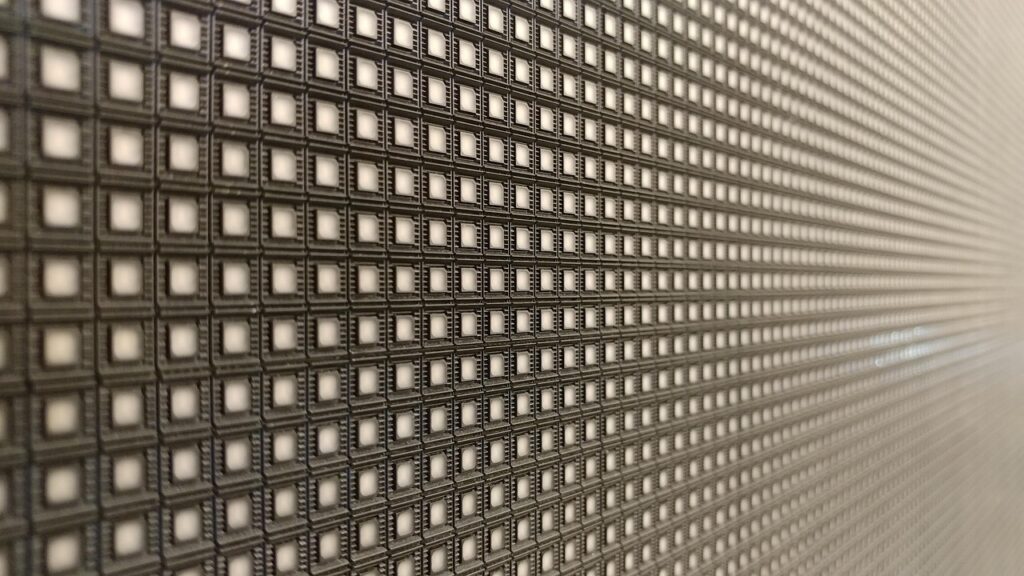
The Pixels: Every image is made of pixels. On an LED wall, each pixel is a tiny cluster of individual Light Emitting Diodes (LEDs)—one Red, one Green, and one Blue (RGB). By mixing the intensity of these three primary colors, each pixel can produce millions of different hues.
-
The Modules: These individual pixels are grouped together on circuit boards to form panels or modules. These modules are the building blocks of the entire wall.
-
The Processor: This is the “brain” of the operation. A specialized video processor takes a standard video signal (from a computer, camera, or media player), intelligently maps it across the entire grid of modules, and tells every single pixel exactly which color to display and when. This complex, high-speed process is what ensures the entire wall acts as a single, perfectly synchronized screen.
4. What is “pixel pitch” and why does it matter?
Pixel pitch is one of the most important specifications of an LED wall. It is simply the distance, measured in millimeters (mm), from the center of one pixel to the center of the next.
The rule is simple and crucial for choosing the right display:
-
A smaller pixel pitch (e.g., 1.9mm) means the pixels are closer together. This creates a higher resolution and allows the image to look sharp and clear even from a close viewing distance.
-
A larger pixel pitch (e.g., 6mm) means the pixels are further apart. This results in a lower resolution and is best suited for applications where the audience will be viewing the screen from a significant distance.
5. What key factors determine the quality of an LED video wall?
While there are many specifications, the overall quality and performance generally come down to a few core elements:
-
LED Quality: The consistency, color accuracy, and durability of the individual LEDs have a major impact on the wall’s overall color uniformity and its lifespan.
-
Brightness & Contrast: Measured in “nits,” brightness determines how well the display will perform against ambient light. High brightness is essential to remain visible—a crucial factor for a storefront window here in sunny Punjab, for example.
-
Refresh Rate: A high refresh rate ensures that video playback is smooth and free of flicker, which is especially important for any application involving broadcast or video recording.
-
Cabinet Construction: The physical frames that hold the modules must be precision-built. This ensures the modules align perfectly without any gaps or seams, creating that flawless, unified image.
Conclusion
Now that you understand the fundamentals of how an LED video wall works—from its modular design to the importance of pixel pitch—you are better equipped to evaluate this powerful technology. Whether for advertising, information, or entertainment, these dynamic displays offer a versatile and impactful way to share a visual message. To connect with experts hit the Link.